2 April 2026
Share of Voice vs Market Share
One of the most enduring rules in marketing is surprisingly simple:
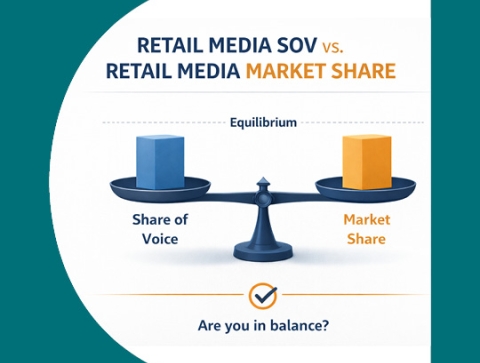
In the long run, a brand’s Market Share tends to align with its Share of Voice (SOV).
The logic is straightforward:
- If your SOV exceeds your Market Share, you’re building future growth potential.
- If your SOV falls below your Market Share, you may gradually lose competitive momentum.
And this principle applies to retail media too.
Today, brands can measure their Retail Media Share of Voice within the total retail media mix (RM SOV) and understand whether their visibility within retailer ecosystems supports their category ambition.
But like most marketing rules, context matters.
A category leader, already dominant and deeply established, may sustain a lower RM SOV for a period of time without immediately losing ground. Strong distribution, brand equity and habitual purchase create resilience.
A challenger brand, however, doesn’t have that luxury.
To grow, defend visibility, and stay top of mind, its RM SOV needs to match — or exceed — its Market Share. Especially in retail environments, where visibility at the point of purchase directly impacts performance.
At MMD, we often ask brands a simple question:
- Is your visibility on shelf and online consistent with the role you want to play in your category?
- Is your Retail Media Share of Voice aligned with your growth ambition?
Because in retail media, SOV isn’t just a branding metric. It’s a growth lever.